By William Santana Li
Founder, Chairman and CEO, Knightscope, Inc. (NASDAQ: KSCP)
| LinkedIn |
In recent blogs I made an argument, not an introduction.
I argued that the Chief Security Officer (CSO) has spent thirty years as a second-class citizen — left to integrate eight to twelve vendors by hand, while the Chief Information Security Officer (CISO) down the hall consolidated to a single Managed Service Provider (MSP) two decades ago. I argued that ownership is not a footnote — that when the company guarding your people answers to a foreign parent, so does the living blueprint of where you are exposed.
Those were arguments about why. This one is about what.
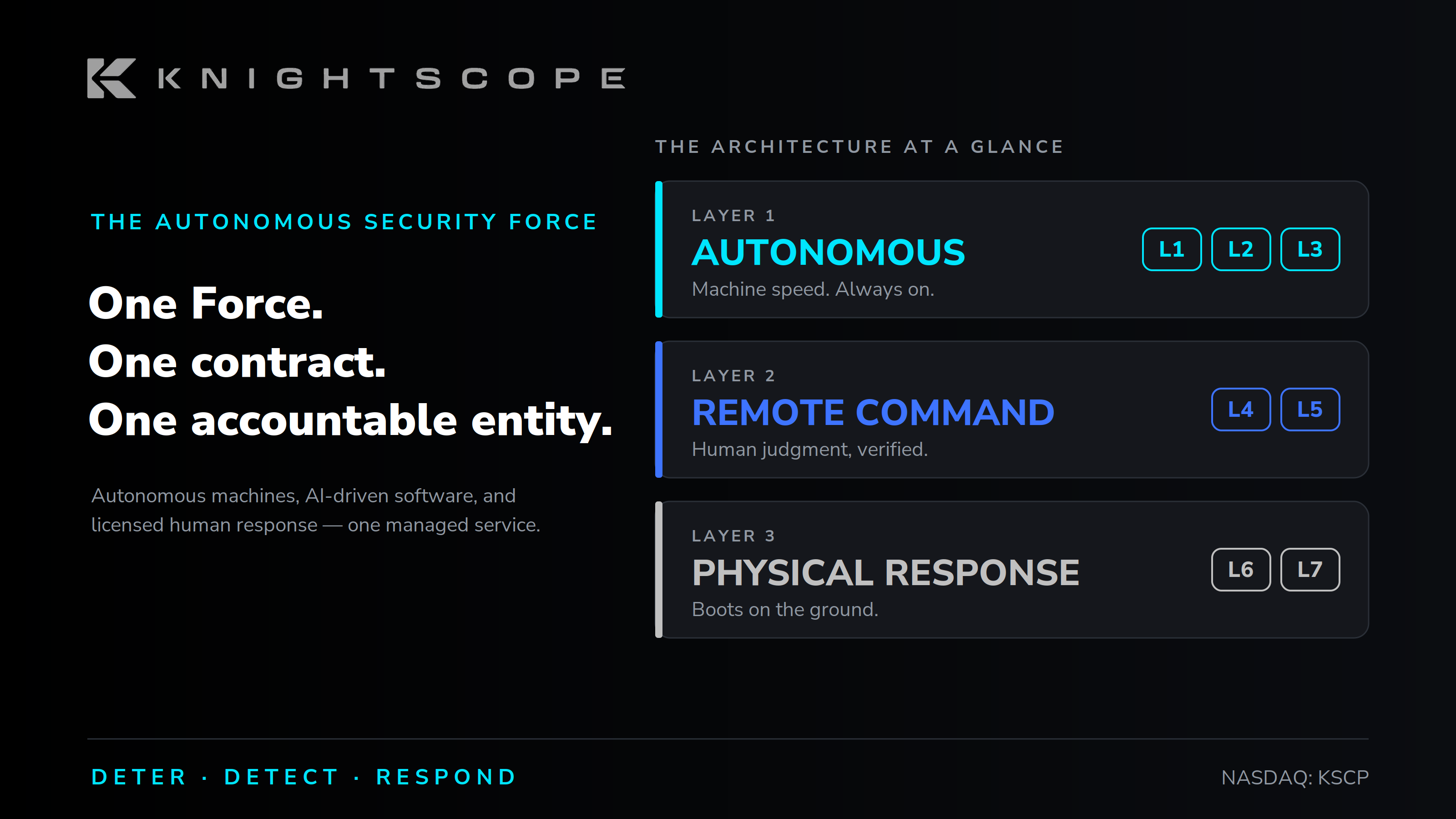
We call it the Autonomous Security Force (ASF). It is not a robot. It is not a piece of software. It is not a guard contract. It is an operating model — an integrated managed service that does for the physical perimeter what the MSP did for the digital one. We do not sell machines. We deliver outcomes: faster detection-to-dispatch, fewer false alarms, a lower cost per protected hour, and an auditable record you can hand to your board without flinching.
One provider. One contract. One entity accountable for the outcome — not the invoice.
The service runs on a simple loop, and we have described it before in this series because it does not change.
Deter. Visible presence changes behavior. Persistent patrol and unmistakable security signature across every entrance, every perimeter, every gap — the kind of footprint legacy guarding cannot maintain at any price.
Detect. Seeing more is not the goal. Signal over noise is the goal. Roughly nine in ten legacy alarms are false; the work is surfacing the one that is real and clearing the rest before a human ever touches them.
Respond. Security only counts when it produces documented action. Verification, escalation, dispatch, reporting — every incident handled the same way, every action logged.
Deter. Detect. Respond. Delivered as one managed system, not three contracts you are left to wire together.
Here is the part the industry has never been able to show you.
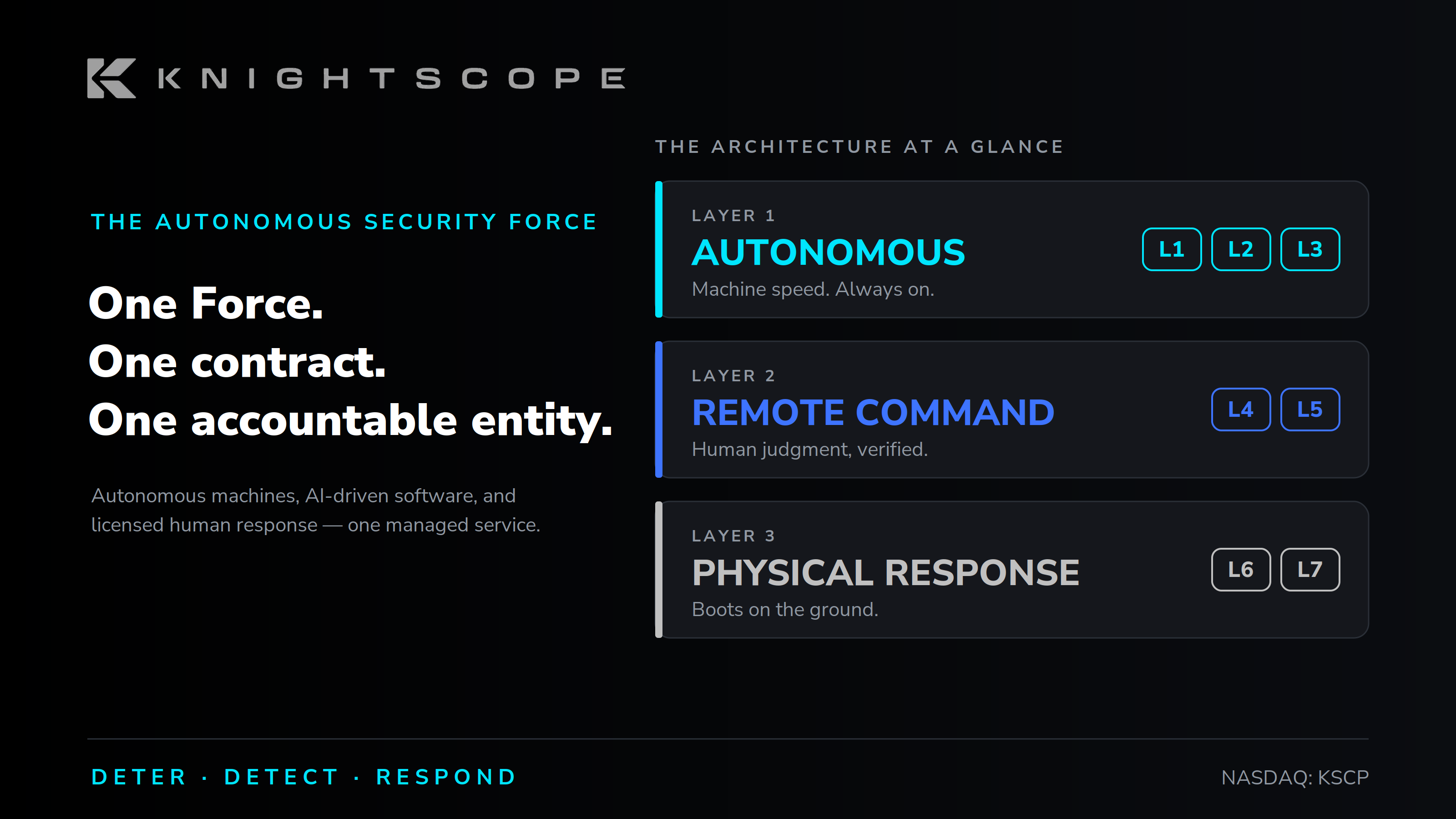
Every event in your program — every tripped sensor, every figure on a fence line, every door forced at 3 a.m. — escalates the same way, through the same chain, every time. We engineered that chain as a single system and named it the ASF-7 escalation model: seven levels, organized into three coordinated layers. It runs from autonomous detection at machine speed, through verified human command, to physical response on the ground.
Level 1 · Autonomous Detection. Autonomous Security Robots (ASR) and connected sensors patrol, capture, and classify activity around the clock — across the visible, infrared, and millimeter-wave spectrum, indoors and out, in daylight, darkness, and weather. This includes a retrofit capability that turns the blue light towers you already own into nodes inside the Force.
Level 2 · AI Agents. This is where false-alarm fatigue ends. Artificial Intelligence (AI) agents triage, classify, and auto-resolve routine events before they ever reach a person. We engineered the noise out of the workflow so your team stops chasing shadows.
Level 3 · Orchestrated Autonomy. Machines and AI coordinate without human intervention — cameras cue one another, robots reposition toward the signal, automated warnings deploy at the threshold of escalation. The first three levels of your program operate while your people focus on the work that requires a person.
This is our Mission Intelligence — the structural equivalent of the cybersecurity Security Operations Center (SOC) the CISO has run for years.
Level 4 · Mission Intelligence Analyst. Human verification of every event the autonomous layer escalates. Real-time documentation. Controlled intervention — talk-down, dispatch coordination, stakeholder notification.
Level 5 · Mission Intelligence Lead. Risk assessment, escalation authority, command decisions. The accountable human in the loop — and the named individual on the receipt.
Level 6 · Augmented Security Agent (ASA). A vetted, licensed, continuously trained officer — armed or unarmed — on post, supported by live machine intelligence and the Mission Intelligence team in their ear. They feed the platform from the field and receive direction from command in return.
Level 7 · Law Enforcement Engagement. Public authority engaged once the legal threshold is met — with auditable proof-of-work, scene reconstruction, and the evidence a real investigation requires.
Seven levels, three layers, hundreds of sensors, dozens of agents, thousands of decisions a day. None of it matters if it does not move as one. Signals is the orchestration layer that fuses every sensor, machine, and human into a single operating picture — a live, three-dimensional view of your locations, with structured escalation from autonomy to human command and a complete audit trail from detection through resolution.
For the first time in this industry, every patrol, every sensor check, every escalation, every action is logged, timestamped, and exportable. Your finance chief can defend the invoice. Your carrier can underwrite the program. Your board can read the quarterly report.
Trust, but verify. Finally, you can do both.
The CISO has had this operating model for twenty years. One architecture. One escalation owner. One accountable party when the audit committee asks the only question that matters: what are we getting for the money.
The Autonomous Security Force brings that standard to the physical perimeter at last — autonomous machines, AI-driven software, and licensed human response, under one contract, answerable for the outcome.
Knightscope is building the nation's first Autonomous Security Force.
For you – the Chief Security Officers of the United States of America.
SECURITY. HANDLED.