Security has always been a human mission: protect people, property, and operations. But the way the industry delivers security at scale is increasingly misaligned with modern risk.
Costs rise every year while outcomes remain inconsistent. Staffing is constrained. Technology deployments multiply, yet most systems remain fragmented and reactive. Coverage still scales linearly with headcount, and too much security infrastructure generates noise instead of actionable intelligence.
The result is a model that is expensive, difficult to manage, and increasingly difficult to defend, which is why Knightscope is building the Nation’s first Autonomous Security Force. It is not a single robot or a standalone technology. It is a new operating model for physical security that integrates hardware, software, and human response into one managed security operation designed to deliver measurable outcomes.
Security performance is constrained by visibility.
Every system has limits. Cameras cover defined angles. Guards can only be in one place at a time. Sensors generate alerts that still require interpretation and verification. When these elements operate independently, gaps form. Those gaps are where incidents occur, and those gaps are where accountability breaks down.
Most organizations do not suffer from a lack of security tools. They suffer from a lack of integration, coordination, and ownership.
When an incident happens, the questions are always the same:
An Autonomous Security Force is designed to close these gaps by expanding field of view, improving verification, and delivering consistent documentation and response.
An Autonomous Security Force is a managed security operation built around three integrated components:
The critical point is integration. These are not separate tools purchased and stitched together. They operate as one coordinated system, designed to deliver continuous coverage and consistent outcomes.
Fragmented security is no longer viable at scale.
Autonomy in this context is not about replacing humans. It is about increasing operational capacity and reducing blind spots, while ensuring that detection leads to accountable action.
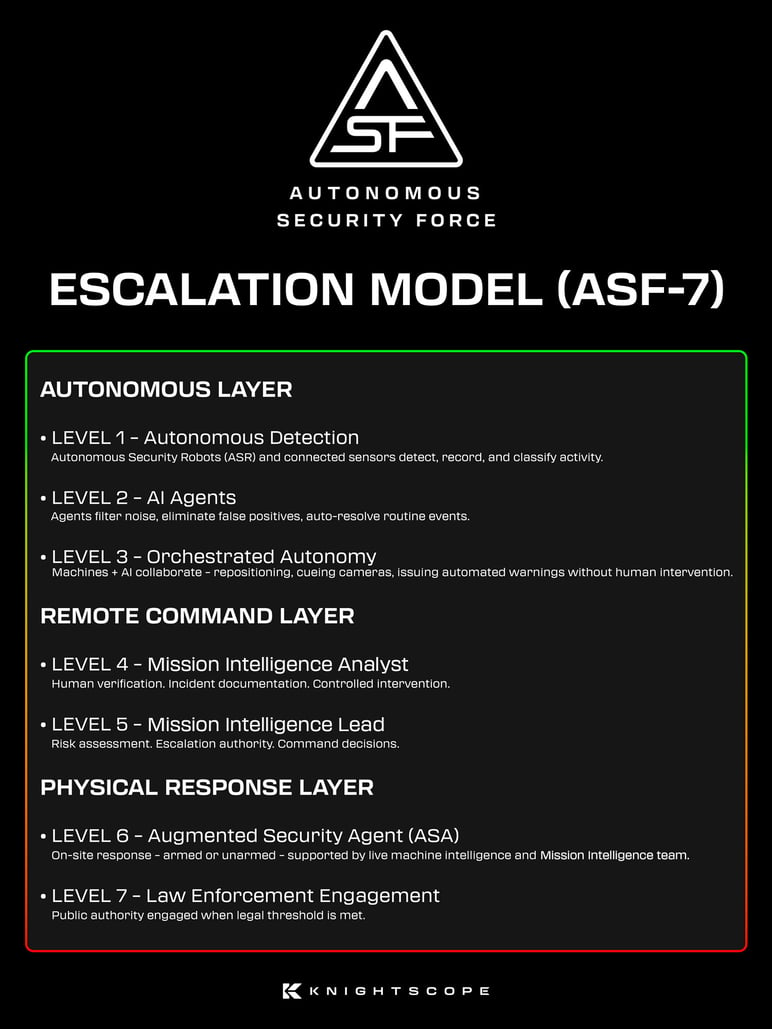
An Autonomous Security Force is built around a simple operating loop.
Visible presence changes behavior. Autonomous patrol, dynamic routing, and public communication capabilities create a persistent security footprint that traditional coverage models struggle to maintain.
Seeing more is not enough. The objective is signal over noise. Sensor fusion and analytics allow teams to detect meaningful events faster, with fewer false positives and less operator fatigue.
Security only counts when it results in documented action. Verification, escalation, dispatch coordination, and reporting ensure that incidents are handled consistently and defensibly.
Deter. Detect. Respond. Managed as one system.
Physical security is not a one-time install. It is a 24/7 operational discipline with real liability.
Most procurement processes reflect that. RFPs and RFQs are written around response, escalation, and accountability, not hardware features. A technology deployment without an operational model is often treated as a project, not a solution.
This is why an Autonomous Security Force must be delivered as a managed model. A managed approach reduces the burden on internal teams and establishes a clear owner for outcomes, including monitoring, escalation, documentation, and continuous improvement.
In practice, many autonomy deployments fail to scale because they treat response as an afterthought. An Autonomous Security Force is built to address response as a core requirement, not an optional add-on.
As security becomes more AI-enabled, human personnel remain essential, especially for verification, judgment, and response.
Most organizations still require licensed coverage, compliance alignment, and defined escalation workflows. That reality does not disappear simply because better technology exists.
In this model, guarding resources remain a critical part of the transition. They help:
The future of physical security is not purely human or purely automated. It is coordinated. It is integrated. And it is accountable.
For security leaders evaluating autonomy, the process should be disciplined and operational, not hype-driven.
Identify where incidents can occur without being seen, verified, or documented. If you cannot answer this quickly, you have blind spots.
If a new system increases complexity instead of reducing it, it will not improve outcomes.
Ask who owns 24/7 monitoring, escalation, documentation, and continuous improvement. If the answer is “you,” it is not a solution. It is a deployment.
An Autonomous Security Force is a new operating model for physical security.
It integrates hardware, software, and human response into one managed system designed to reduce blind spots, improve verification, and deliver consistent, documented outcomes.
This is not autonomy for novelty. It is autonomy applied with operational discipline.
Because the future of security will not be defined by who has the most tools. It will be defined by who can deliver the most accountable results. Knightscope is building this model because the market has moved beyond disconnected tools and expects accountable, always-on security operations.
