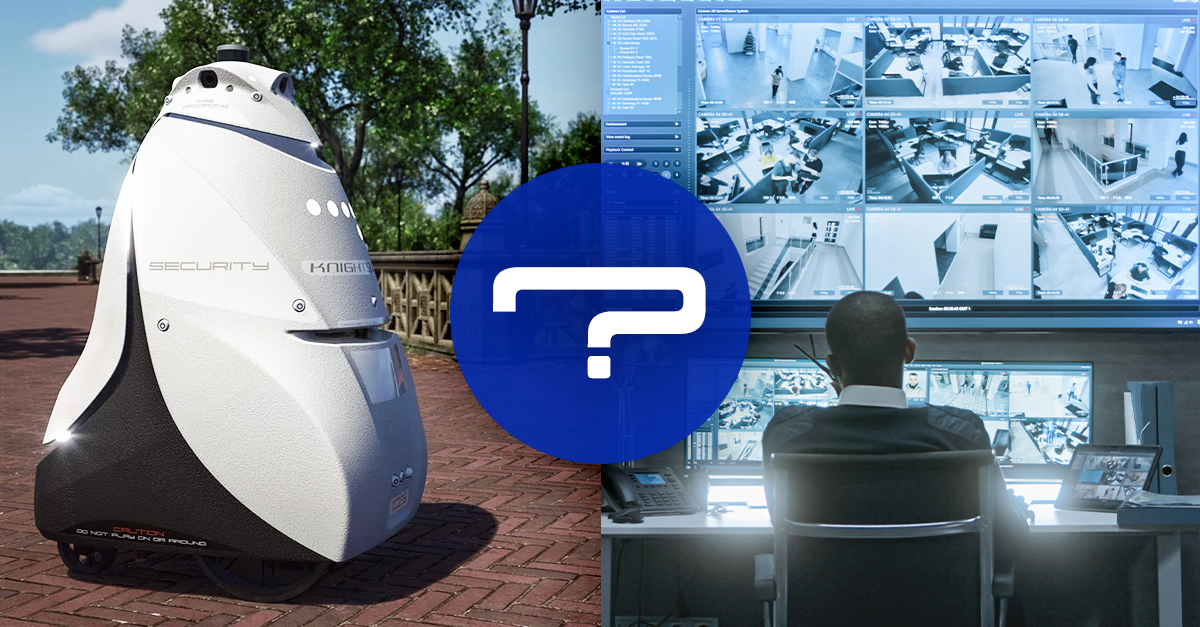
For decades, physical security has framed progress as a choice.
It’s an easy debate to have – and the wrong one to be having. Because security outcomes do not fail because people are involved, or because technology falls short.
They fail when responsibility is fragmented across tools, vendors, and roles that were never designed to operate as a single system.
Choosing sides has become a substitute for designing security to work.
Most security environments today are haphazardly assembled, not designed.
Each component serves a purpose. But ownership is scattered, and accountability is diluted.
Security has spent the last two decades integrating vendors: connecting cameras to software and linking access control to monitoring platforms. But vendor integration is not the same as operating model integration. When responsibility to detect, deter, and respond remains split across contracts and systems, accountability remains fragmented.
When incidents occur, it’s rarely because no one cared or nothing was deployed. More often, incidents expose the seams between sensing, interpretation, and response:
It breaks down at the point of coordination.
Human guards have played a central role in security for centuries. They bring judgment, authority, and the ability to intervene in ways machines cannot. That hasn’t changed, and it won’t. What has changed is the environment they’re expected to cover.
The U.S. Bureau of Labor Statistics projects continued demand for security guards even as labor shortages and wage pressures persist, reinforcing the economic limits of scaling through headcount alone.
As the Founder and CEO of Event Risk, Eric Rose, put it:

Even well-run guarding programs struggle to maintain consistent visibility, decision-making, and response across time and geography –especially as expectations for documentation and accountability increase.
Technology promises leverage, but on its own it introduces a different constraint.
Sensors, cameras, and analytics generate enormous volumes of data. Alerts without context create noise. Tools without coordinated response shift work onto already overloaded teams.
Security teams end up:
The result is not better security; it’s slower response, alert fatigue, and reliance on hindsight.
Technology can extend reach, but it cannot close the loop on its own.
Research across industries, including McKinsey’s work on automation, consistently shows that technology delivers the greatest value when paired with operating model redesign, not when layered onto fragmented workflows.
Early conversations about autonomy in security often focused on reducing reliance on human guards. That framing made sense. Engineers are trained to reduce variability, and people are the largest source of it.
But real-world deployments tell a more nuanced story. As Knightscope deployed autonomous security systems at scale, a clear pattern emerged:
Security outcomes do not fail because humans or tech are part of the system. They fail when human judgment is disconnected from the systems generating information and triggering response.
Persistent autonomy exposes edge cases. In other words, autonomy more accurately uncovers ambiguity, context, and situations that can’t be resolved by rules or alerts alone. It also reveals where human expertise adds the most value, which is being engaged at the right moment, with the right information.
The lesson isn’t that automation replaces people. It’s that automation changes how people should be involved.
We’ve seen this adoption pattern before. Autonomous systems tend to gain traction first in environments where failure carries limited consequence. Only after repeated, real-world exposure do they move into enterprise and regulated sectors, where accountability and reliability matter more than novelty.
What changes adoption isn’t hype. It’s confidence that systems are persistent, intelligible, governable, and accountable in real-world operations
Security leaders aren’t asking if autonomy exists. They’re asking how it should be integrated, supervised, and held accountable. In other words, robots shouldn’t work alone.
This is why Knightscope is building the Nation’s first Autonomous Security Force: a single, managed operating model that integrates:
Delivered together, with end-to-end accountability.
Knightscope’s acquisition of Event Risk reflects this shift — bringing licensed response, executive protection, and human expertise into the same accountable structure that governs autonomous detection and monitoring.
Guards are not the destination. They are the deployment catalyst — enabling autonomy to operate within the realities of today’s procurement, regulatory, and risk environments.
The future of security will not be defined by who deploys the most technology or hires the most people. It will have humans and robots working together. But more importantly, it will be defined by who:
The debate between guards and technology is the wrong one to be having.
The future belongs to integrated forces, managed as one system and accountable for results.
